
How to Play Blackjack With Every Blackjack Rule Explained Before Your First Hand
 By CasinoCircle Team·
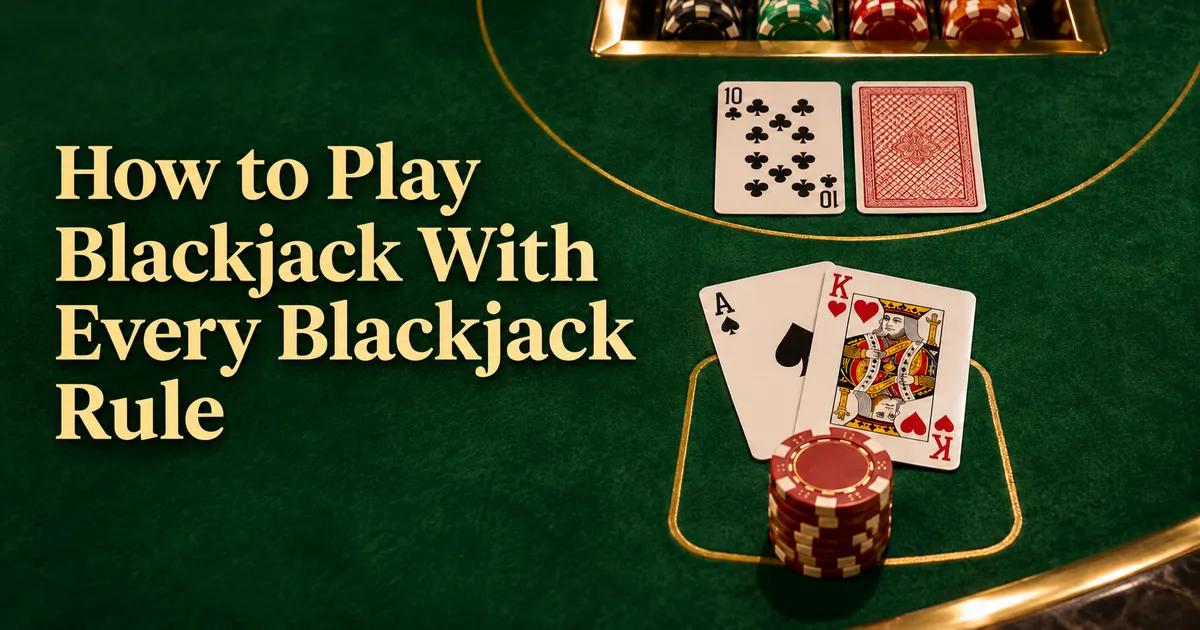
Blackjack has one simple aim: finish closer to 21 than the dealer without going over. The blackjack rules behind that aim take five minutes to learn, and knowing them well is what separates a player who guesses from one who plays every hand with a plan. This guide shows you how to play blackjack in the order a real round unfolds, then gives you the strategy chart, the payouts to look for and the way the game works on live and online tables in Malaysia. It's written for first-timers and for slot players trying the table games for the first time.
01The Goal of Blackjack and Why 21 Is the Number to Chase
In blackjack you play against the dealer, not against the other players at the table. Everyone at the table can win the same round, and nobody's hand affects whether yours wins.
You win a hand in one of three ways:
- Your total beats the dealer's without going over 21.
- The dealer busts. If the dealer's hand goes over 21, every player still in the round wins.
- You get a natural blackjack. An Ace plus any 10-value card in your first two cards is a blackjack, the best hand in the game. It pays more than a normal win.
Two words you'll hear on every table:
- Bust means your total went over 21. You lose straight away, even if the dealer busts later.
- Push means you and the dealer finish on the same total. Nobody wins, and you get your bet back.
That first point about busting is where the house gets its edge: you act before the dealer, so if you bust, you lose before the dealer has played a card.
02What Every Card Is Worth at the Blackjack Table
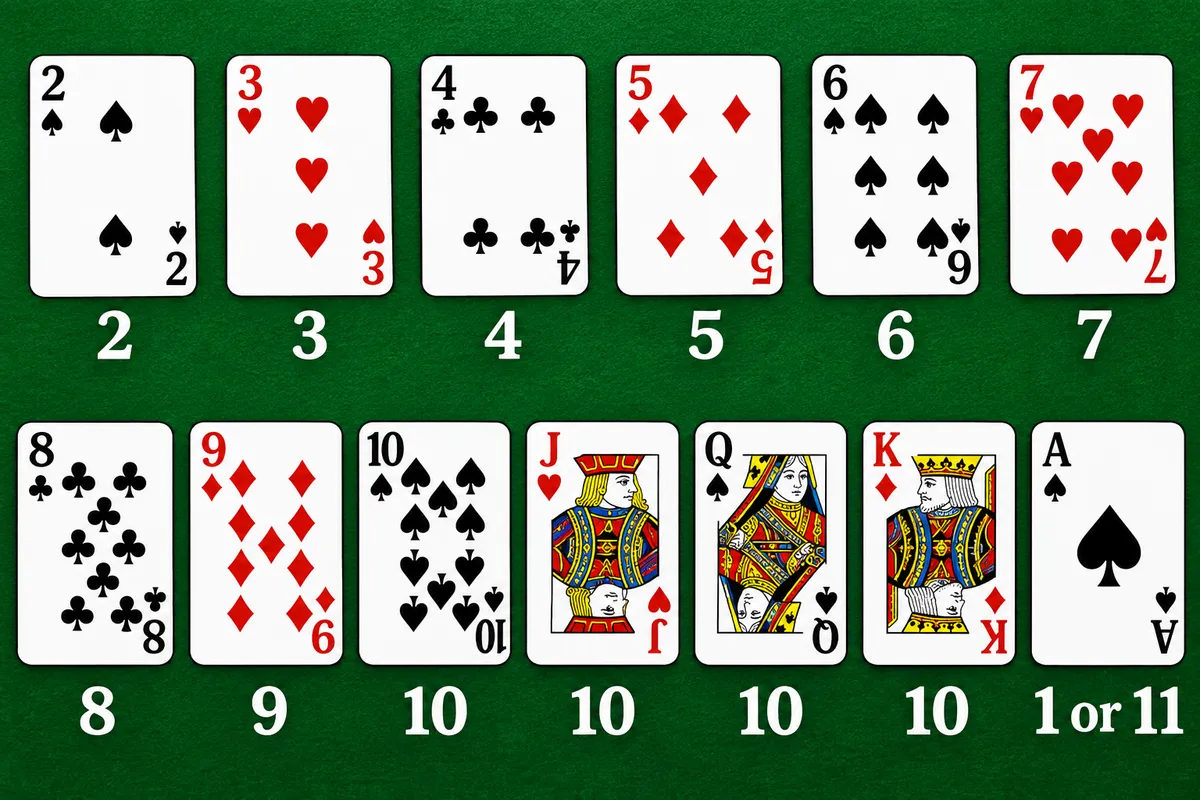
Suits don't matter in blackjack. Only the number counts.
Card | Value |
2, 3, 4, 5, 6, 7, 8, 9, 10 | Face value |
Jack, Queen, King | 10 |
Ace | 1 or 11, whichever helps your hand |
Because the Ace can switch value, hands come in two kinds:
- A soft hand has an Ace counted as 11. Ace-6 is a soft 17. You can't bust it with one more card, because the Ace drops to 1 if you'd go over.
- A hard hand has no Ace, or an Ace that must count as 1. 10-7 is a hard 17, and any card above a 4 busts it.
Knowing whether your hand is soft or hard changes the right play, so it's worth checking every time you look at your cards.
03How to Play Blackjack, One Round at a Time
Every round at a blackjack table follows the same order.
Place your bet. Put your chips in the betting box before any cards are dealt. The table's minimum and maximum bets are shown on the table sign or, online, on the game screen.
The deal. Each player gets two cards face up. The dealer gets one card face up (the upcard) and, at most tables, one face down (the hole card).
Check for blackjack. If you hold an Ace and a 10-value card, you have blackjack and are paid at once, unless the dealer also has blackjack, which is a push. When the dealer's upcard is an Ace or a 10, many tables have the dealer check the hole card for blackjack before anyone plays on.
Your turn. Starting on the dealer's left, each player decides how to play their hand: hit, stand, double, split or surrender. The next section explains each choice.
The dealer's turn. Once every player has finished, the dealer turns over the hole card and plays the hand by fixed rules: draw until the total reaches 17 or more.
Settle the bets. Winning hands are paid, losing hands are collected and pushes are returned. Then the next round begins.
A worked example
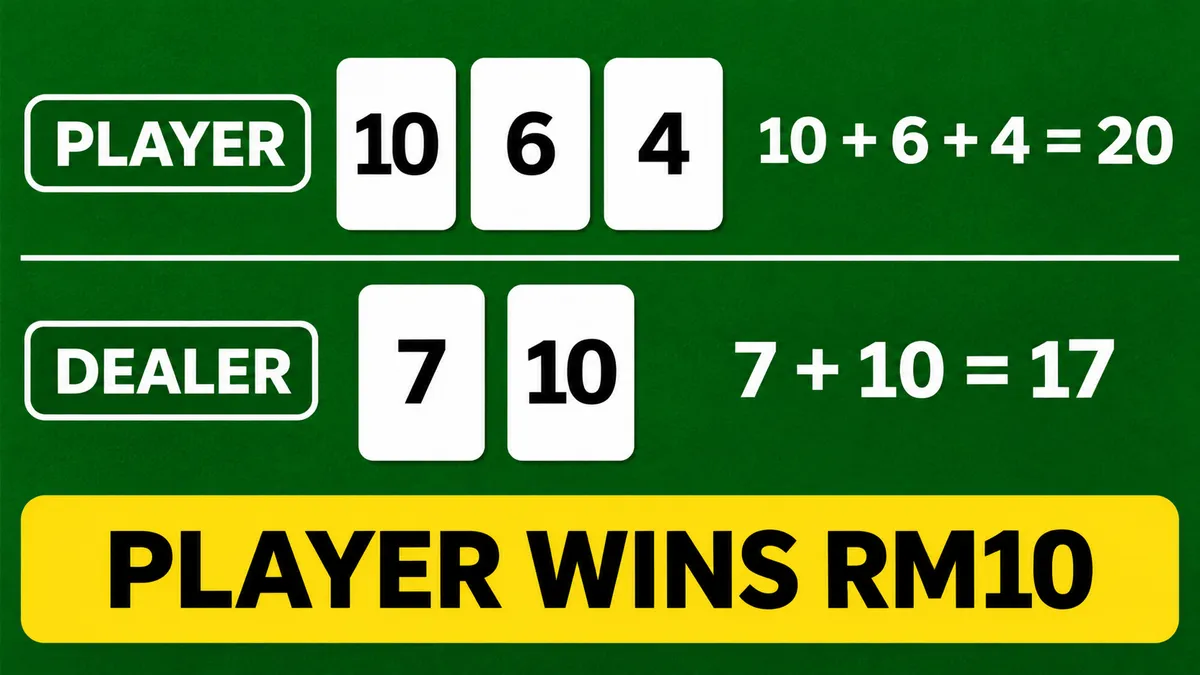
You bet RM10 and get a 10 and a 6, a hard 16. The dealer shows a 7.
A 16 is a weak hand, and a dealer 7 suggests a likely 17. Standing on 16 only wins if the dealer busts, so the right play is to hit. You draw a 4 and now hold 20, so you stand.
The dealer turns over a 10 for a total of 17 and must stand. Your 20 beats 17, and you're paid RM10, so you take back RM20 in total.
04Hit, Stand, Double or Split, Your Choices on Every Hand
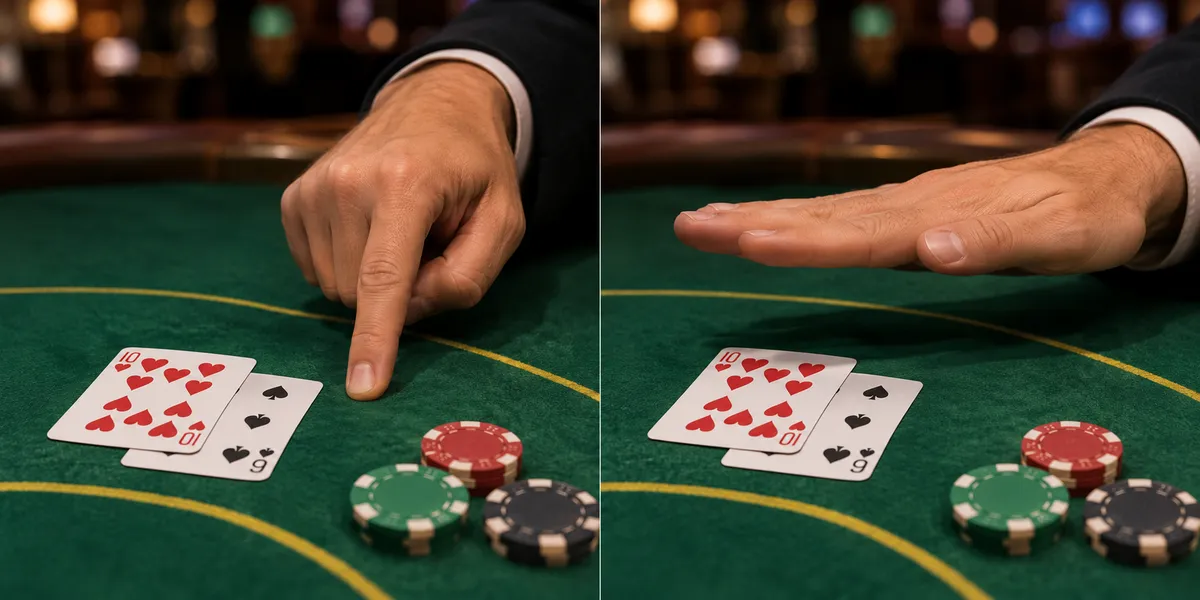
Hit. Take another card. You can hit as many times as you like until you stand or bust. Tap the table in a land casino; online, press Hit.
Stand. Keep your total and end your turn. Wave your hand flat over your cards, or press Stand.
Double down. Double your bet and take exactly one more card. It's the strongest play when your first two cards total 10 or 11 and the dealer looks weak. Some tables only let you double on 9, 10 or 11.
Split. If your first two cards are a pair, split them into two separate hands with a second bet of the same size. Each hand then gets a second card and plays on its own. Most tables limit splitting to three or four hands. Split Aces usually get only one card each, and an Ace plus a 10 after a split counts as 21, not blackjack.
Surrender. Give up your hand straight after the deal and get half your bet back. Not every table offers it, but when it's available it saves money on the worst hands, like a hard 16 against a dealer 10.
Insurance. When the dealer shows an Ace, you can place a side bet of up to half your stake that the dealer has blackjack. It pays 2:1. It sounds safe, but the dealer has blackjack less than a third of the time, so in the long run insurance loses money. Skip it. "Even money" on your own blackjack against a dealer Ace is the same bet under another name.

05The Blackjack Rules That Make the Dealer Hit on 16 and Stand on 17
The dealer makes no choices. The house rules decide every move:
- On 16 or less, the dealer must hit.
- On 17 or more, the dealer must stand.
The one variation is the soft 17 (an Ace plus cards totalling 6). The table will state one of two rules:
- "Dealer stands on soft 17" (S17). The dealer stands on Ace-6. This is the better rule for you.
- "Dealer hits soft 17" (H17). The dealer draws again, which helps the house slightly.
The rule is usually printed on the felt or listed in the game's rules screen. When you have the choice, pick the S17 table.
For your own hand, the answer to "hit on 16 or 17?" is in the chart below. In short: stand on a hard 17, and hit a hard 16 when the dealer shows 7 or higher.
06Blackjack Payouts, Including the 3:2 vs 6:5 Trap
Result | Pays | On an RM100 bet |
Normal win | 1:1 | RM100 profit |
Natural blackjack (3:2 table) | 3:2 | RM150 profit |
Natural blackjack (6:5 table) | 6:5 | RM120 profit |
Insurance (dealer has blackjack) | 2:1 | RM100 profit on an RM50 insurance bet |
Push | Stake returned | RM0 |
The difference between a 3:2 table and a 6:5 table looks small, but it costs you RM30 every time you're dealt blackjack on an RM100 bet. Over a long session, a 6:5 payout adds more to the house edge than almost any mistake you could make at the table. Look for "Blackjack pays 3 to 2" on the felt or in the game rules before you take a seat.
07Blackjack Strategy That Cuts the House Edge
Blackjack is the one casino game where your decisions change the odds. Blackjack basic strategy is the best play for every hand you can hold against every card the dealer can show, worked out by computer over millions of hands. Played perfectly on a good table, it brings the house edge down to about 0.5%.
Learning how to play blackjack basic strategy takes an evening. Keep this blackjack cheat sheet open while you play. It's built for the most common table: several decks, dealer stands on soft 17, and doubling allowed after a split.
Blackjack chart: hard totals
Your hand | Dealer shows 2–6 | Dealer shows 7–Ace |
8 or less | Hit | Hit |
9 | Double on 3–6, hit on 2 | Hit |
10 | Double | Double on 7–9, hit on 10 or Ace |
11 | Double | Double on 7–10, hit on Ace |
12 | Stand on 4–6, hit on 2–3 | Hit |
13–16 | Stand | Hit |
17 or more | Stand | Stand |
Blackjack chart: soft totals
Your hand | Play |
Ace-2, Ace-3 | Double on dealer 5–6, otherwise hit |
Ace-4, Ace-5 | Double on dealer 4–6, otherwise hit |
Ace-6 | Double on dealer 3–6, otherwise hit |
Ace-7 | Double on dealer 3–6, stand on 2, 7 or 8, hit on 9, 10 or Ace |
Ace-8, Ace-9 | Stand |
Blackjack chart: pairs
Your pair | Play |
Ace-Ace, 8-8 | Always split |
10-10 | Never split; stand |
9-9 | Split on dealer 2–6, 8 or 9; stand on 7, 10 or Ace |
7-7 | Split on dealer 2–7, otherwise hit |
6-6 | Split on dealer 2–6, otherwise hit |
5-5 | Never split; play as a hard 10 |
4-4 | Split on dealer 5–6, otherwise hit |
2-2, 3-3 | Split on dealer 2–7, otherwise hit |
If surrender is offered, surrender a hard 16 against a dealer 9, 10 or Ace, and a hard 15 against a dealer 10.
Five rules if you can't remember the whole chart
- Always split Aces and 8s.
- Never split 10s or 5s.
- Double on 11 against everything except an Ace.
- Stand on 12–16 when the dealer shows 2–6, and hit them when the dealer shows 7 or higher (except 12 against a 2 or 3: hit).
- Never take insurance.
These five lines cover most of the hands you'll be dealt, and they're a good blackjack strategy to start with before you learn the full chart.
Betting systems such as Martingale, where you double your bet after every loss, change how much you stake but not the odds of any hand. They don't belong in a winning plan.

08Live Blackjack Malaysia Players Can Join From Their Phone
Live blackjack Malaysia lobbies play by the same blackjack rules as a land table, but the experience differs in a few ways worth knowing before you sit down.
RNG tables and live dealer tables. The online blackjack Malaysia players find in a casino lobby comes in two forms. RNG (random number generator) blackjack is a computer game: cards are shuffled by software for every hand, and you play at your own pace. Live dealer blackjack is streamed from a studio with a real dealer, real cards and a real shoe. Any mobile online casino Malaysia players use with a live lobby streams these tables straight to your phone.
A decision timer. Live tables give each player a short countdown to act. If time runs out, the game usually stands for you, so know your chart before you join.
Bet behind. When all the seats are full, you can bet on a seated player's hand. You win or lose with their decisions, and you don't choose the plays.
The dealer's second card. Many live tables follow the European style: the dealer gets the second card only after every player has finished. Read the game rules to see what happens to doubled and split bets if the dealer then turns over a blackjack.
Side bets. Most live tables offer extras such as Perfect Pairs (your first two cards are a pair) and 21+3 (your two cards plus the dealer's upcard make a poker hand like a flush or straight). They pay big multiples, but their house edge is several times higher than the main game. Treat them as an occasional extra, not a strategy.
Shared-hand and "free bet" games. Some live games deal one hand that an unlimited number of players share, each making their own decisions. Others give free doubles and splits on certain hands, but pay a push when the dealer busts with 22. Each changes the right strategy slightly, so read the game's rules screen first.
Stakes. The minimum and maximum bets in ringgit are shown on each table's lobby tile. Live tables usually start higher than RNG blackjack, so RNG tables are a cheaper place to practise the chart.
09How to Count Cards in Blackjack, and Why It Rarely Works Online
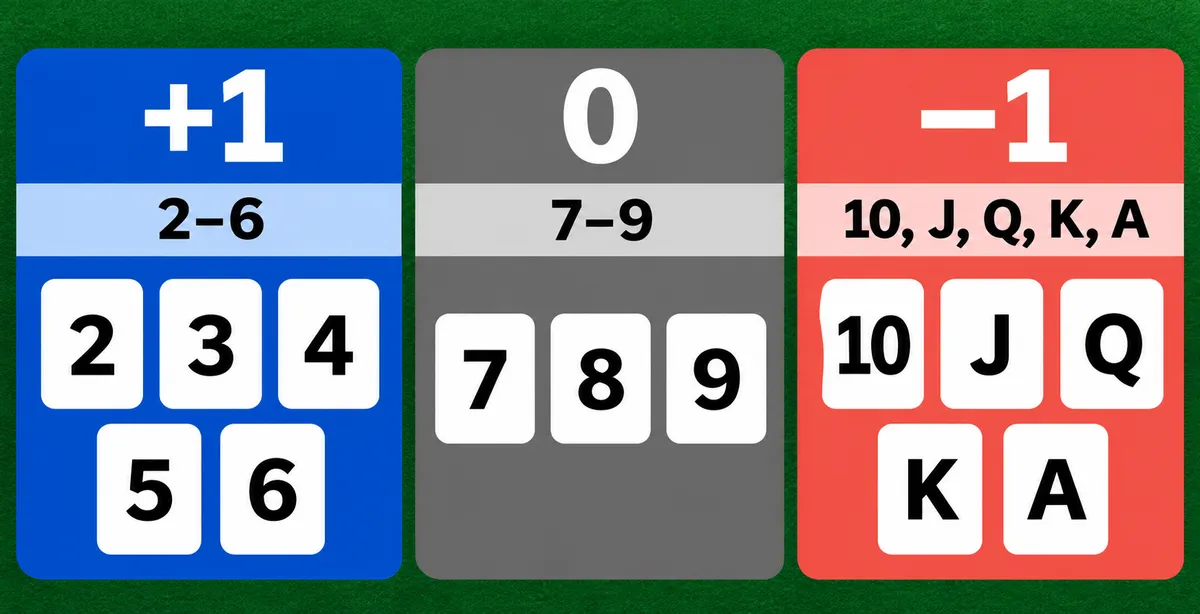
Card counting tracks which cards have already been dealt so you know when the remaining cards favour you. The best-known method, Hi-Lo, gives each card a value:
- 2, 3, 4, 5 and 6 count +1
- 7, 8 and 9 count 0
- 10s, picture cards and Aces count −1
You keep a running total as cards come out. A high positive count means plenty of 10s and Aces are left in the shoe, which favours the player, so counters raise their bets. Dividing the running count by the number of decks left gives the "true count", the figure counters actually bet on.
That's how to count cards in blackjack in principle. In practice online, it rarely works:
- RNG blackjack reshuffles every hand, so the count resets before it can tell you anything.
- Live tables reshuffle early, often around halfway through the shoe, so the count rarely climbs high enough to help.
Counting isn't cheating, and it isn't against the law, but land casinos can ask a counter to stop playing. For most players, basic strategy is a far better use of the effort.
10How to Win at Blackjack More Often and the Mistakes That Cost Players Most
No method wins every session, because the house keeps a small edge. Knowing how to win at blackjack more often comes down to playing the chart and avoiding the mistakes that hand the house extra money.
The closest thing to a golden rule of blackjack: never take insurance, and play the chart, not your gut. A useful habit behind the chart is to assume the dealer's hidden card is a 10, because 10-value cards make up almost a third of the deck.
The mistakes that cost players most:
- Standing on 12 against a dealer 2 or 3. It feels safe, but hitting wins more often.
- Not doubling on 11. It's one of the best chances in the game to win a bigger bet.
- Splitting 10s. A 20 is already a winning hand most of the time. Splitting it throws that away.
- Playing 6:5 tables. The lower blackjack payout costs more than most bad plays.
- Chasing losses. Raising your bets to win back a bad run only makes the run more expensive.
Set your budget before your first hand and stop when it's gone. Blackjack is a game you play for fun, and the chart is there to make your money last longer.
11Blackjack FAQ
Are blackjack and 21 the same game? Yes. Blackjack 21 is simply the full name some players use, and "21" was the game's original name before casinos added a bonus for an Ace with a black Jack. The rules are the same.
Do you hit on 16 or 17? Stand on a hard 17. On a hard 16, hit when the dealer shows 7 or higher and stand when the dealer shows 2–6. A soft 17 (Ace-6) is different: hit it, or double it against a dealer 3–6.
What is the golden rule of blackjack? Never take insurance, and follow basic strategy rather than hunches. Assuming the dealer's hidden card is a 10 helps you remember why the chart says what it does.
Can the dealer see their hole card? Not during normal play. At tables where the dealer checks for blackjack, a reader device or a quick peek shows only whether the hand is a blackjack, and the dealer reveals nothing else until it's their turn.
What happens if you and the dealer both have blackjack? It's a push. You get your bet back, and nobody wins the hand.
Is online blackjack fair? At a licensed casino, RNG blackjack uses software tested by independent labs, and live blackjack is dealt from real cards on camera. Play at a licensed site, and check the rules screen for the payout and dealer rules before you play.